


The HVAC Interview: Preparing and Dressing for Success

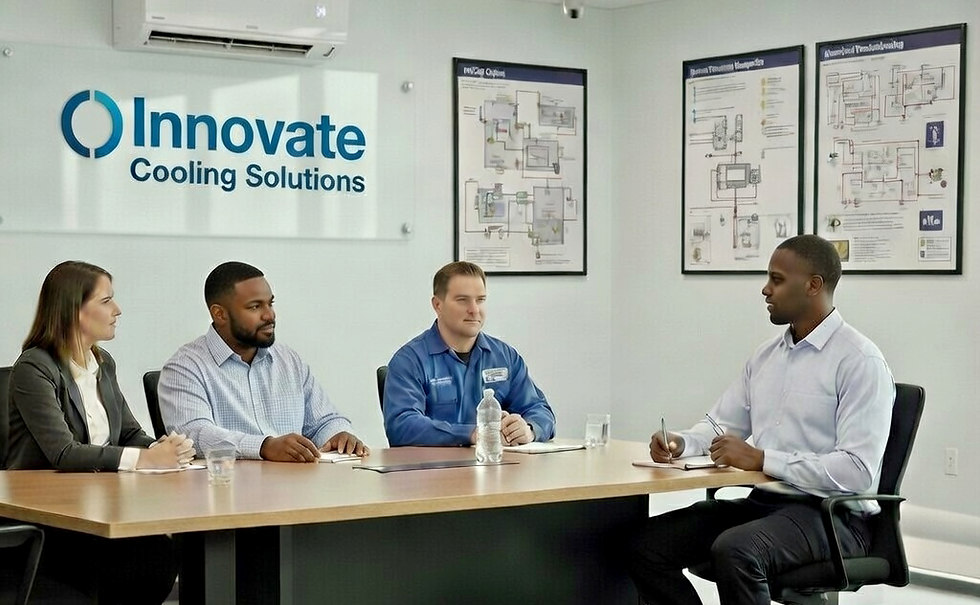
Landing a job in HVAC is unique because every employer has a different philosophy on professionalism. For some, the goal isn't just to look good—it’s to look capable. Here is how to balance a sharp presentation with a "ready-to-work" attitude.
1. The Logistics of Professionalism
Professionalism starts long before you shake hands. Your arrival sets the tone for your reliability in the field.
The Golden Rule of Time: If you’re on time, you’re late. Aim to be early.
The Dry Run: Drive to the location the day before your interview. Identify potential obstacles like school zones, heavy traffic patterns, or train crossings that could delay you.
Parking Strategy: Identify a place to park that is legal, out of the way of company service vans, and doesn't block any bay doors.
The Vehicle Inspection: Ensure your car is clean inside and out. Many owners are watching the moment you drive onto the lot. If trash falls out of your door when you get out, it suggests you’ll treat their expensive service van the same way.
2. Prove Your Preparedness: The Portfolio
Don't just tell them you’re a pro; show them. Bringing a physical portfolio sets you apart from 90% of other applicants.
The Essentials: Carry a professional folder or binder containing at least three extra copies of your resume.
Certifications & Training: Include copies of your EPA card, certifications, and training completions from any manufacturer-specific training classes you’ve taken.
The Driving Record: In HVAC, your license is your livelihood. Bringing a fresh, clean driving record proactively shows you are insurable and responsible.
Social Proof & Reviews: Include printouts of positive customer feedback or Google/Yelp reviews that mention you by name.
The "Proof of Craft" Gallery: Include clear photos of your best work—clean ductwork, perfectly leveled condensers, and organized wiring. It proves you take pride in the "art" of the install.
Performance History: Include your most recent performance reviews. Showing that a previous boss valued your work ethic builds immediate trust.
3. The "Gig Line" Attire
The goal is to bridge the gap between a professional office and a mechanical room.
The Boots: Wear work boots. It signals that you are a technician. Ensure they are clean; if they are brand new, scuff them up slightly so you don’t look like a rookie.
The Pants: Opt for black work pants that are ironed and fit properly. If you wear jeans, make sure they are not baggy nor too tight.
The Belt: Go for a simple black belt. No large belt buckles or flashy designs.
The Shirt: A long-sleeve, button-down shirt in a solid color is your best bet. Keep it tucked in.
The "Gig Line": Ensure your shirt placket (buttons), belt buckle, and pants fly are perfectly aligned. This shows immense attention to detail.
The tie is optional. If the interviewer is more casual, you can quickly take it off and say you're ready to work.
The blazer is overkill for most field interviews. There are some employers that look for it, but it often sends too much of an office or sales message rather than a technician image.
4. Communication & Character
Technicians are the face of the company. Your interview is a test of how you will treat a homeowner.
First Impressions: Walk to the door with confidence. Stand tall, use good posture, and look people in the eye.
The "Everyone" Rule: Treat every person you encounter—from the receptionist to the parts runner—with respect. Be positive and kind to everyone.
The Past is Past: Do not bad-mouth your previous employer. Use generic, professional answers regarding your reasons for leaving.
Honesty: Do not lie. If you don’t know an answer, say so—but explain how you would find it (manuals, tech support, etc.).
5. Mastery of the Response
Structure your answers to show you can handle the pressure of the trade.
The STAR Method: When asked about past experiences, use this structure:
Situation: Set the scene.
Task: Describe what needed to be done.
Action: Explain exactly what you did.
Result: Share the positive outcome.
The Notebook: Bring a notebook with questions written down ahead of time. Take notes while they speak; it shows organization.
Volume & Clarity: Speak clearly and with volume. Many owners who were former techs may have hearing loss; speaking up shows confidence.
6. The "Jump-In" Kit
The best HVAC interviews end with a ride-along. Be the candidate who says "yes" without hesitation.
The Tool Bag: Bring it. It balances your clean clothes with the reality of the trade. It shows that you are ready to work and have the tools to do so. Shoe covers in your pocket are a bonus.
The Change of Clothes: Keep a spare t-shirt and pair of work pants in your vehicle. If they ask you to jump in a van for a ride-along, you’re ready to go without ruining your interview clothes. Even better, go in your interview clothes and show your commitment.
The Close: Don't leave things up in the air. Ask about the next steps and, most importantly, ask for the job.
Pro Tip: If you're looking for affordable but sharp work pants, check out Sam’s Club. They often carry durable brands that look professional but are built for the field.

STAR Method Examples:
These are designed to show the interviewer that you don't just "do" HVAC—you solve problems and manage customers.
Here are three common HVAC scenarios structured to help you land the job:
1. The Difficult Customer Scenario
Interviewer: "Tell me about a time you dealt with an unhappy homeowner."
Situation: I arrived at a "no-cool" call on a 100-degree day. The customer was already frustrated because the previous company had been there twice and the AC was still down.
Task: I needed to calm the customer down while accurately diagnosing the system under pressure.
Action: I listened to her vent without interrupting. I then performed a systematic check, found a loose low-voltage wire the others had missed, and explained the fix using simple terms.
Result: The unit stayed running, and the customer was so relieved that she wrote a 5-star review specifically mentioning my patience and thoroughness.
2. The Complex Technical Repair
Interviewer: "Describe a time you encountered a technical issue you couldn't immediately solve."
Situation: I was working on a high-efficiency communicating system that was throwing an intermittent communication error code that didn't make sense.
Task: I had to find the root cause rather than just "parts-changing" on the company's dime.
Action: I didn't guess. I admitted to the customer I wanted to be 100% sure before proceeding. I pulled up the manufacturer's manual, checked the shielded wire for interference, and called the factory tech support line to verify my readings.
Result: I found a nick in the wire behind a wall. I bypassed it, the system cleared, and I saved the company the cost of an unnecessary $800 control board.
3. The "Above and Beyond" Service
Interviewer: "Give me an example of how you provide great customer service."
Situation: While finishing a routine furnace maintenance, I noticed the homeowner was struggling to move some heavy storage boxes near the unit.
Task: My job was the furnace, but my goal was to leave the customer better off than I found them.
Action: I stayed an extra five minutes to help him relocate the boxes, ensuring they weren't blocking the return air or creating a fire hazard near the burner.
Result: The customer felt cared for, and he ended up signing a three-year maintenance contract because he trusted that I actually cared about his home's safety.
Pro-Tips for the STAR Method:
Keep it under 2 minutes: Be concise.
Use "I", not "We": They are hiring you, not your old team.
Quantify if Possible: Mentioning things like "saved 20% in labor" or "zero callbacks for six months" sound great to a manager.
Here are three STAR examples tailored for a recent graduate of an online HVAC program:
1. The "Problem-Solving & Troubleshooting" Scenario
Interviewer: "Since you haven't worked in the field yet, how do we know you can handle a complex mechanical breakdown?"
Situation: During my online HVAC course, we had a virtual simulation (or lab) where a heat pump was short-cycling, and the cause wasn't obvious.
Task: I needed to diagnose the issue using only the electrical schematics and the virtual multimeter readings provided.
Action: Instead of guessing and swapping parts, I followed a systematic sequence of operations. I traced the voltage from the thermostat to the contactor and discovered a faulty high-pressure switch that was tripping prematurely.
Result: I successfully resolved the simulation on the first attempt. It taught me that following a logic-based diagnostic process is faster and more accurate than "parts-changing."
2. The "Commitment to Learning" Scenario
Interviewer: "HVAC is a tough trade to learn online. How did you ensure you actually mastered the material?"
Situation: I realized that watching videos wasn't enough to truly understand how to properly braze or use a manifold gauge set.
Task: I wanted to bridge the gap between "online theory" and "hands-on reality."
Action: I invested in my own basic tool set and a recovery tank. I spent my weekends practicing on an old window unit and a scrap condenser I found, following the EPA 608 guidelines I learned in class to ensure I was practicing safely and legally.
Result: By the time I finished the course, I wasn't just book-smart; I had developed the muscle memory for using my tools, which is why I brought my Tool Bag and Certifications with me today.
3. The "Transferable Customer Service" Scenario
(Use this to show you can handle homeowners by pulling from a previous job like retail, food service, or delivery.)
Interviewer: "Technicians have to deal with grumpy homeowners. Do you have experience with that?"
Situation: In my previous job at [Previous Job], I had a customer who was upset because an order was late and incorrect.
Task: I needed to de-escalate the situation and represent the company professionally.
Action: I used active listening to let them speak, stayed positive, and didn't take their frustration personally. I offered a clear solution and followed through until they were satisfied.
Result: The customer calmed down and thanked me for the help. I plan to bring that same level of "cool-headed" service to every "no-cool" call I run for you.
Advice for the "Green" Tech:
Own the "Newness": Don't try to fake 10 years of experience. Instead, highlight your reliability and hunger to learn.
Reference the Portfolio: When you give these answers, point to your Training Certificates or Photos of the equipment you've practiced on. It proves you aren't just talking.
Learn more about growing in the field by taking our Online Courses here!
Check out our Free Calculators here!
If you want to learn about refrigerants and how they work in a system, check out our “Refrigerant Charging and Service Procedures for Air Conditioning, 2nd Ed” book .
Test your knowledge with our 1,600 question workbook along with the answer key!
We also have quick reference cards for use out in the field!
Bundle Packs are a great way to save and get faster shipping! Check out www.acservicetech.com/store
Tools that we use: www.amazon.com/shop/acservicetech

Published: 2/26/2026 Author: Ty Branaman
About the Author: Ty is a nationally renowned HVACR Teacher that has over 20 years experience teaching high school, post secondary, and in-field technician students. Ty started Love2HVAC because his passion is HVACR training, education, and motivation of skilled tradespeople. He invests in people by producing online training videos, performing live presentations, and running GRIT camps across the country. Ty can be reached at ty@love2hvac.com and his video library is available here: https://www.youtube.com/c/TyBranaman

.png)


The dry run and vehicle inspection tips really hit home—especially not blocking bay doors or company service vans, since that says “ready to work” before you even shake hands. “If you’re on time, you’re late” is going straight into my notes. By the way, I keep a free AI tool that turns two photos into a viral fairy-tale tiptoe dance video I like to share: https://wakestill.com/
The dry run tip really hit home—especially checking for train crossings and school zones before an HVAC interview, since reliability starts before you even park. I also appreciated the reminder not to block bay doors or company service vans; that’s the kind of detail that shows you get the field. By the way, I keep a free AI tool that turns two selfies into a fun rap duo video I like to share: https://wakepix.com/
XX8 xuất hiện trong một topic mình tình cờ đọc được trên forum khi đang tìm lại thông tin cho một chủ đề khác. Vì thấy vài thành viên nhắc đến nên mình tiện tay mở thử, chủ yếu xem cách trang được bố trí chứ không tìm hiểu sâu. Bố cục nhìn khá gọn, từng khu vực được sắp xếp rõ nên dễ theo dõi và không tạo cảm giác quá nhiều chữ. Mình thử truy cập bằng điện thoại, chuyển qua các phần cũng tương đối thuận tiện.
trang chủ xx88 tình cờ lọt vào tầm mắt khi mình xem một bảng dữ liệu có nhiều mã viết tắt và ký hiệu khác nhau. Thấy cách ghi khá ngắn gọn, mình mở trang liên quan để xem thêm một chút rồi quay lại công việc đang làm. Ấn tượng ban đầu là phần đầu trang không quá rối, tiêu đề nổi bật vừa đủ và các khu vực nội dung có khoảng cách hợp lý. Mình chưa kiểm tra kỹ từng tính năng, chỉ lướt sơ để nắm cách sắp xếp thông tin.
Lần đầu biết đến https://llwin.social/ , mình bắt gặp cái tên này khá nhiều trong những bài thảo luận về nền tảng giải trí trực tuyến. Từ sự tò mò, mình đã truy cập thử để xem cách website vận hành cũng như quan sát phần giao diện bên ngoài. Cảm nhận đầu tiên là trang được thiết kế theo hướng khá tối giản, các khu vực chính được sắp xếp tương đối dễ nhìn và màu sắc không gây cảm giác quá chói. Quá trình thao tác cũng khá ổn, thời gian tải trang tương đối nhanh và việc chuyển đổi giữa các mục diễn ra khá mượt. Dù vậy, mình vẫn giữ thái độ thận trọng vì chưa có…